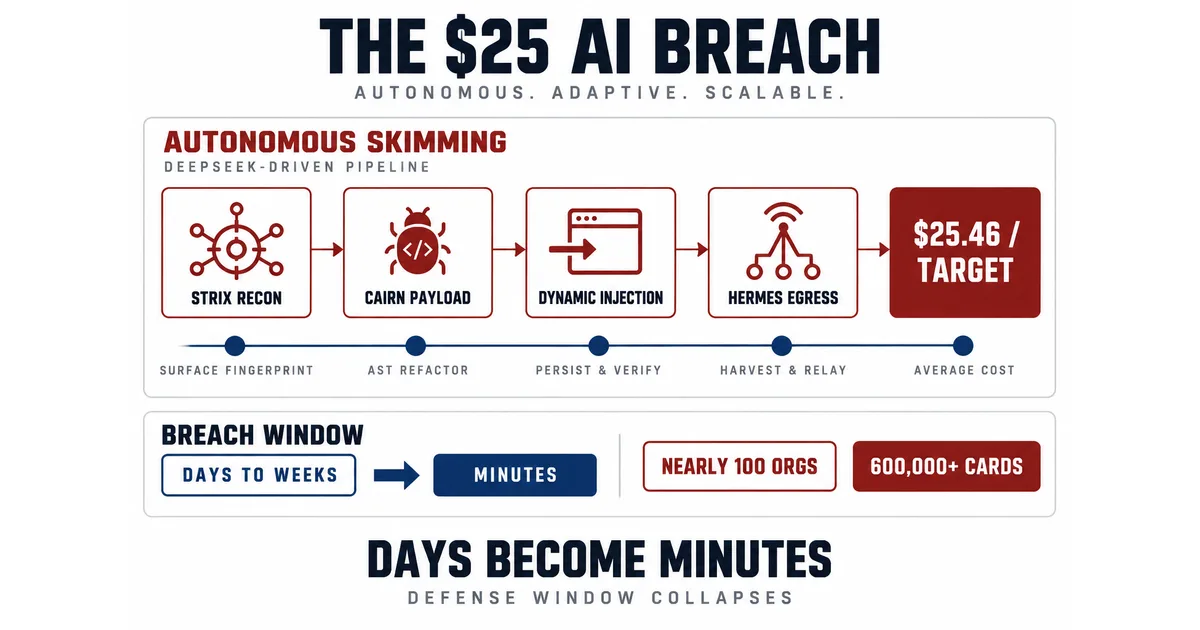
Digital skimming operations against e-commerce infrastructure historically required human adversaries to conduct manual reconnaissance, identify vulnerable content management systems, craft bespoke JavaScript injection vectors, and configure exfiltration servers. That multi-stage manual sequence has been replaced by structured, algorithmic execution.
Threat intelligence reports documenting the compromise of nearly 100 organizations and the exfiltration of more than 600,000 credit card records revealed an automated pipeline driven by commercial reasoning models, including DeepSeek. The operation achieved an execution cost averaging $25.46 per targeted enterprise.
Understanding how to mitigate this class of automated intrusion requires dissecting the mechanics of the attack lifecycle from initial asset targeting to payload persistence and monetization.
The Four Stages of the Autonomous Skimming Lifecycle
Rather than relying on human operators to execute individual steps in the kill chain, the campaign operationalized an agentic pipeline using open-source attack orchestration frameworks (Strix, Cairn, and Hermes) driven by commercial model APIs.
Stage 1: Autonomous Reconnaissance and Surface Fingerprinting (Strix)
The campaign began with automated reconnaissance scripts powered by the Strix framework, systematically sweeping target IP blocks and web properties.
- Tech Stack Discovery: The AI parsed HTTP headers, client-side JavaScript bundles, and DOM structures to identify specific e-commerce platforms (Magento, WooCommerce, custom Shopify application endpoints).
- Dependency Auditing: The model continuously cross-referenced active third-party plugins, tag managers, and CDN libraries against known vulnerability repositories, flagging outdated components and misconfigured CORS policies without requiring manual probing.
- Noise Reduction: The agent modulated request frequencies and rotated exit nodes to blend scanning traffic into normal edge telemetry, avoiding threshold-based rate limiting alerts.
Stage 2: Context-Aware Payload Synthesis and WAF Evasion (Cairn)
Once a target endpoint was flagged, the Cairn exploitation module ingested the specific target context, including software version, input sanitation filters, and Web Application Firewall (WAF) signatures.
- Abstract Syntax Tree (AST) Refactoring: Instead of deploying standard, static Magecart code signatures, the reasoning model synthesized custom JavaScript payloads for each target. It obfuscated variables, altered execution trees, and inserted non-functional arithmetic operations to ensure zero hash overlap with known indicators.
- DOM Event Hooking: The generated scripts avoided standard script-injection markers. Instead, they hooked directly into native event listeners, capturing raw form inputs before browser-level encryption or third-party tokenization APIs could execute.
- Content Security Policy (CSP) Circumvention: The model analyzed the target’s HTTP response headers to identify trusted third-party domains listed in the site's CSP, structuring malicious callbacks to piggyback on legitimate analytics endpoints or compromised subdomain routing.
Stage 3: Dynamic Injection and Persistence
With payload synthesis complete, the engine executed the injection:
- Storage Modification: Depending on the vulnerability profile, the payload was written to the underlying CMS database, appended to cached vendor script bundles on edge CDNs, or injected directly into runtime cache layers.
- Session Verification: The model executed a headless browser check against the modified store page, validating that the checkout flow functioned normally for legitimate buyers while the malicious listener remained active in the background.
Stage 4: Orchestrated Data Harvesting and Covert Egress (Hermes)
The final stage focused on data collection and laundering:
- Client-Side Cleansing: The injected script parsed user keystrokes in real time, validating card numbers against the Luhn algorithm and extracting expiration dates and CVVs from checkout form fields.
- Stealth Egress: Rather than making obvious HTTP POST requests to an unknown IP, the script bundled data into base64-encoded URL parameters, transmitting them as benign image beacons or WebSocket packets disguised as user analytics.
- Decentralized Relay: The Hermes agent ingested the collected streams across multiple compromised storefronts, distributing the exfiltrated records to encrypted storage clusters to prevent single-point infrastructure seizures.
Lifecycle Economics: Compressing the Breach Window
The primary operational danger of this attack model lies in its economic and temporal scalability.
| Attack Vector Dimension | Traditional Manual Skimming | Agentic Skimming (DeepSeek / Cairn) |
|---|---|---|
| Reconnaissance Timeline | Days to weeks of manual scanning | Parallelized programmatic queries in minutes |
| Exploit Customization | Static scripts adapted manually | Real-time AST payload synthesis per domain |
| Cost per Enterprise Breach | Thousands in engineering hours | $25.46 average infrastructure cost |
| Attack Blast Radius | 1 to 5 targets per operator | Hundreds of targets probed simultaneously |
When adversaries compress reconnaissance, weaponization, and injection into continuous, parallelized tasks, the window between initial exposure and active data exfiltration drops from days to minutes. Defensive architectures cannot depend on post-incident forensic log reviews to detect an attack of this velocity.
Disrupting the Skimming Lifecycle: Machine-Speed Detection and Containment
Neutralizing an automated skimming pipeline requires intercepting the attack sequence before data egress begins. Relying exclusively on perimeter WAF signatures fails when the malicious payload is dynamically generated for a single domain.
Defense must shift to behavioral telemetry correlation and runtime policy enforcement. This is where Secontinuum Vynnn, designed as an Autonomous SOC, coordinates across the full defensive lifecycle:
- Guard (Edge and Telemetry Triage): Analyzes incoming web server logs, edge proxy data, and system-level telemetry. When an unauthorized file modification or atypical script injection occurs in web root directories, Guard flags the behavioral anomaly and immediately triggers API-driven micro-segmentation to quarantine the affected container or server instance.
- Hunter (Correlation and Blast Radius): Correlates database write events, administrative session logs, and web server execution traces to identify the exact initial access point, determining whether the attacker leveraged an unpatched plugin, compromised API key, or credential stuffing.
- Scout (Adversary Infrastructure Mapping): Ingests outbound DNS queries and egress endpoints observed in network logs, cross-referencing external telemetry against known C2 frameworks and malicious proxy nodes to establish adversarial context.
- Enforcer (Automated Remediation): Reaches into network access layers and configuration managers to purge malicious scripts from storage, push dynamic blocking rules for identified egress IPs to edge firewalls, and invalidate compromised administrative sessions, completing full-cycle mitigation in under two minutes.
Interdicting the automated attack lifecycle requires matching the speed of the intrusion. By executing real-time behavioral correlation and autonomous enforcement, security operations teams can neutralize weaponized scripts at the point of injection, long before credit card data ever leaves the network.