The perimeter is no longer just shifting; it is dissolving under the pressure of algorithmic execution. In our recent deep dive, we explored the architecture of HexStrike AI, an integrated, agentic compilation framework designed to automate vulnerability discovery, chain complex exploits, and synthesize polymorphic payloads capable of slipping past traditional Endpoint Detection and Response (EDR) platforms.
We noted that the true frontier of modern cyber warfare lies in autonomous, self-mutating payload delivery. Recent 2026 threat intelligence has observed Advanced Persistent Threat (APT) groups deploying these exact agentic frameworks to conduct live, autonomous cyberattacks against critical infrastructure and enterprise networks.
Specifically, APT29 (also known as Midnight Blizzard or Cozy Bear), a highly resourced, state-sponsored threat actor, has been observed integrating HexStrike AI into their 2026 campaigns targeting the European energy sector and cloud service providers. When adversaries mutate their code and execution tactics dynamically every few minutes, human-led SOCs must evolve.
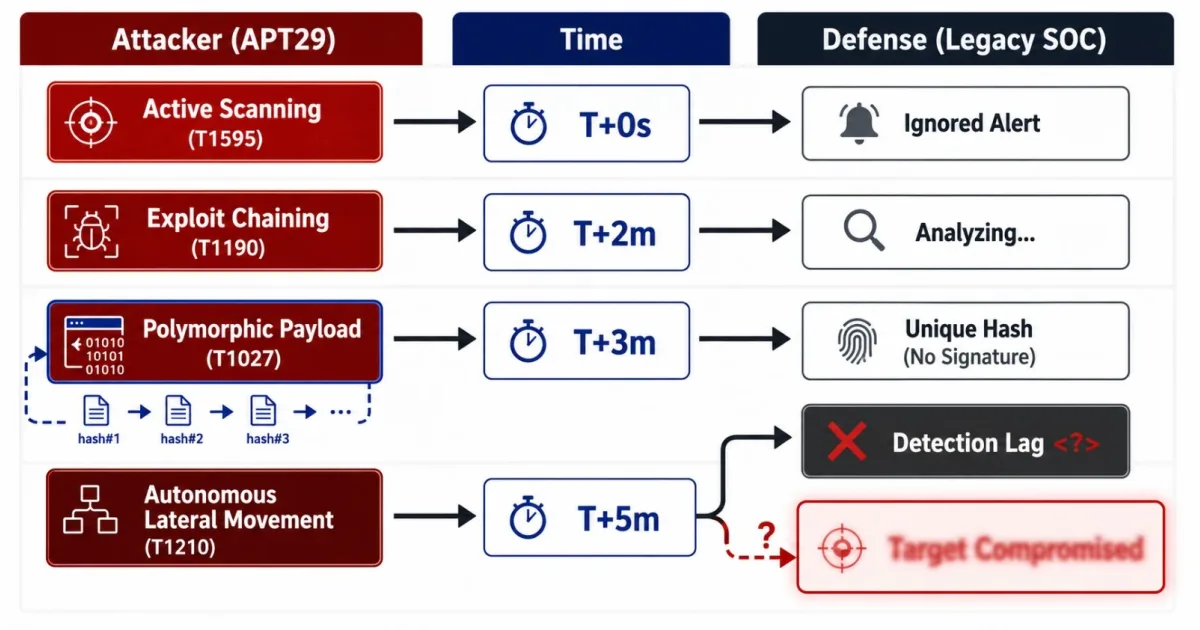
To understand the sheer velocity of these attacks, we must break down this recent APT29 campaign using HexStrike AI, mapped directly across the MITRE ATT&CK framework.
The MITRE ATT&CK Chain: An Autonomous Breach
Unlike legacy attacks where human operators manually move from phase to phase, an APT utilizing HexStrike AI relies on the engine's internal reasoning agents to automate the reconnaissance to execution pipeline. Here is how APT29's autonomous attack chain unfolded in the wild:
1. Reconnaissance (TA0043) & Resource Development (TA0042)
- Technique: Active Scanning (T1595) & Compromise Infrastructure (T1584)
- The AI Advantage: Before launching the attack, APT29 feeds the target enterprise's network footprint into HexStrike AI. The framework's internal reasoning agents immediately map open ports, analyze banner details, and cross-reference active software versions against global CVE repositories. Simultaneously, it intelligently rotates IP addresses across decentralized botnets to mask its scanning activities.
2. Initial Access (TA0001) & Execution (TA0002)
- Technique: Exploit Public-Facing Application (T1190)
- The AI Advantage: Instead of a human operator manually validating individual vulnerabilities over the course of days, HexStrike AI evaluates dependencies in real time. It calculates structural weaknesses across complex software stacks, dynamically packages the precise payload variations required, and fires an automated multi-stage exploit chain in rapid succession.
3. Defense Evasion (TA0005)
- Technique: Obfuscated Files or Information (T1027) & Impair Defenses (T1562)
- The AI Advantage: This is where HexStrike AI completely bypasses traditional endpoint security. When fed a known exploit payload, the engine parses the source code into an Abstract Syntax Tree (AST). The AI then systematically executes structural transformations, such as:
- Control Flow Flattening: Destroying the visual and structural linearity of the program.
- Dead Code Injection: Interleaving functionally useless math equations to alter the cryptographic hash.
- Semantic Token Substitution: Dynamically renaming variables and functions to mimic legitimate internal enterprise software. Because the semantic logic remains completely intact while the syntax is entirely rewritten, the resulting binary yields a unique file hash upon every single iteration, rendering signature based blocking entirely useless.
Furthermore, before deploying this mutated payload to the target environment, the offensive agent spins up ephemeral, lightweight containerized sandboxes. The mutated binary is executed, and the engine captures the specific API calls or memory hooks that trigger an alert. The AI rewrites that precise subset of code and runs the test again, iterating autonomously until it achieves a zero-detection signature.
4. Lateral Movement (TA0008)
- Technique: Exploitation of Remote Services (T1210)
- The AI Advantage: Once inside, the agentic AI immediately pivots. It automatically scans the internal environment for misconfigurations and high privilege targets, mapping out the fastest route to critical data before security teams can even register the initial breach. HexStrike AI effectively moves from the initial exploit to lateral movement in minutes.
- Reference Note: The TTPs (Tactics, Techniques, and Procedures) outlined in this mapping directly correspond to the mid-2026 campaigns attributed to APT29 (Midnight Blizzard). The integration of HexStrike AI allowed APT29 to automate their traditionally manual "low-and-slow" lateral movement, transitioning to machine-speed execution while maintaining their signature evasion capabilities.
Defeating the Algorithmic Threat with Secontinuum
Advanced toolkits like HexStrike AI prove that security architectures built around legacy, manual review models are fundamentally unequipped for tomorrow's vectors.
At Secontinuum, we engineered our Autonomous Agentic SecOps platform specifically to stem the tide of machine-speed polymorphism. We bypass obsolete static indicators entirely, relying instead on continuous, and autonomous defense agents. By embedding agentic intelligence directly into your security operations, we ensure your enterprise adapts, mutates, and neutralizes threats at the exact same speed as the attackers.