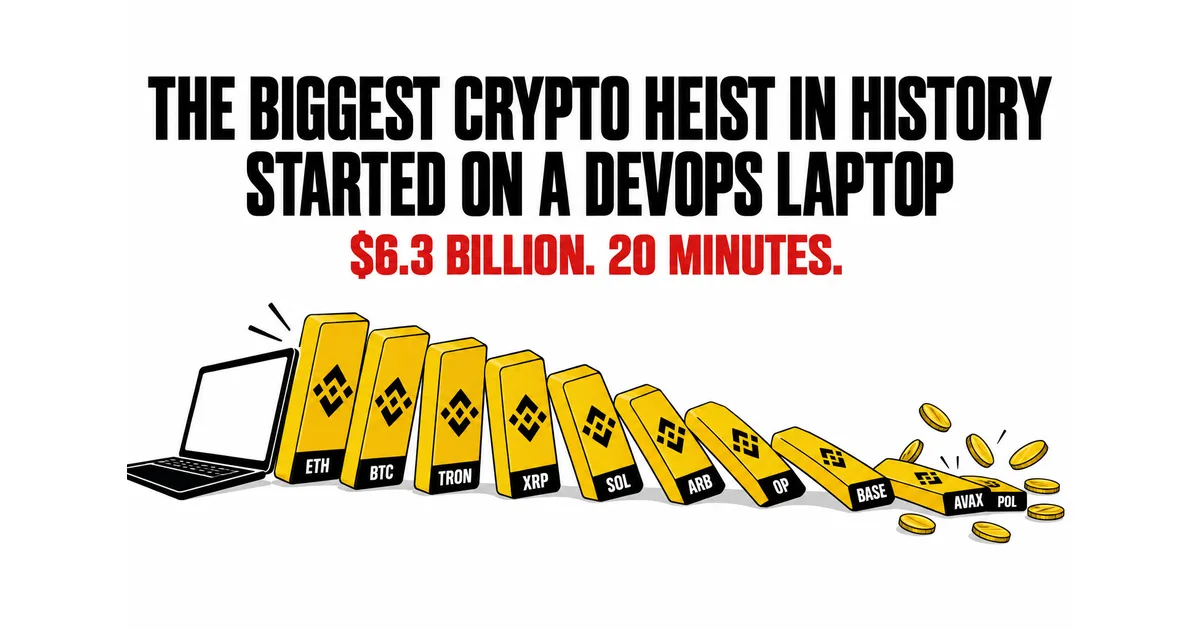
On the evening of October 29, 2026, wallets belonging to Binance, the world's largest cryptocurrency exchange, began sending their balances to a single attacker. The XRP Ledger went first. Then Solana, Optimism, Bitcoin, Tron and Ethereum. Most of the theft was complete in about twenty minutes. By the time it was over, roughly $6.3 billion had left Binance across ten blockchains, making it the largest crypto theft ever recorded and about four times the size of the $1.5 billion Bybit heist in February 2025.
Binance's initial finding is the part every security team should study: the incident appears to have started with a compromised DevOps engineer's laptop, which gave the attacker access to a service container capable of submitting withdrawal transactions. Binance says it has found no evidence that wallet private keys leaked. The attacker did not need them. It only needed the system that uses them.
On October 30, Binance said investigators had uncovered additional points of breach beyond the laptop. This analysis reflects what is publicly known as of that date.
The Attack at a Glance
| Victim | Binance hot wallet infrastructure |
| Date | October 29, 2026 (staging from October 28) |
| Estimated impact | ~$6.3B (Binance); ~$6.36B at time of theft (TRM Labs) |
| Chains affected | Ethereum, Bitcoin, Tron, XRP Ledger, Solana, Arbitrum, Optimism, Base, Avalanche, Polygon |
| Attribution | TraderTraitor (DPRK), high confidence per TRM Labs; Lazarus-linked per independent investigators |
| Initial access (preliminary) | Compromised DevOps engineer laptop leading to a service container |
| Frozen so far | ~$2.7B to $3B, mostly stablecoins |
| Beyond reach | ~$2.4B, largely ETH and BTC |
Timeline: Thirty-Six Hours of Staging, Twenty Minutes of Theft
The theft looked instantaneous. The preparation was not. On-chain evidence reconstructed by TRM Labs shows a deliberate, rehearsed operation (all times UTC):
- Oct 28, morning: The attacker's operator wallet is funded with three small withdrawals from Tornado Cash.
- Oct 29, early: The operator deploys a first version of its attack code and tests it on two wallets.
- Oct 29, later: A final version is rehearsed on a third wallet, with test funds routed back. Four hours later, the same code is installed on a Binance hot wallet.
- 20:05–20:09: Five Binance wallets on the XRP Ledger send 233.46 million XRP to the attacker.
- ~20:10: Binance wallets on Solana and Optimism follow.
- 20:20: A Binance Bitcoin hot wallet sends 18,270 BTC, immediately split into round lots through a peel chain. On Ethereum, the attacker submits a single transaction carrying 50 pre-signed EIP-7702 authorizations.
- ~20:22: A Binance Tron hot wallet sends 612.7 million USDT and 46.4 million TRX.
- 20:24: Three minutes and 24 seconds after the delegation, the hijacked Ethereum hot wallet sends its entire balance, including 167,464 ETH and 1.615 billion USDT, in one transaction.
- 21:01: Tether freezes the main receiving wallet, 37 minutes after the main sweep. Circle follows at 21:04.
- 20:41 to 23:56: The attacker keeps re-sweeping new funds arriving at the compromised wallet, six more times.
- 23:05: A second wave hits Binance wallets on Avalanche and Polygon.
- 00:08, Oct 30: Arbitrum's Security Council forcibly moves about $30 million out of the attacker's wallet.
Two numbers in that timeline matter more than the headline loss. The first is twenty minutes, the time it took to empty wallets on ten chains. The second is nearly four hours, the span during which the attacker was still actively pulling funds out of Binance infrastructure.
How the Attacker Took Control
The EIP-7702 hijack
EIP-7702, introduced in Ethereum's Pectra upgrade in May 2025, lets an ordinary wallet delegate its behaviour to a smart contract by signing an authorization. Once signed, every call to the wallet runs that contract's code until a new authorization replaces it.
The attacker used this to turn one of Binance's best-known Ethereum hot wallets into a sweeper that obeyed only the attacker. The clever part was the nonce problem. An authorization is only valid at the exact transaction count the wallet has reached when it executes, and a busy exchange hot wallet's count moves constantly as it processes withdrawals. So the attacker obtained 50 signatures for 50 consecutive nonces, submitted them together, and let whichever one matched take effect. One did.
Because the delegation persisted, the wallet became a trap: every new deposit that landed in it was swept again. The same wallet also acted as executor for a separate Binance smart account, which exposed a further 823 million USDC, later frozen by Circle.
Not just Ethereum: the signing system itself
Early speculation focused on phished authorizations. But that only explains Ethereum. In the same half hour, Binance wallets on nine other chains, using different key types and signing schemes, produced ordinary, valid signed transfers to the attacker. Another Ethereum hot wallet sent 28,006 ETH with no delegation at all.
TRM's assessment is that the attacker gained the ability to make Binance's hot wallet signing infrastructure sign transactions of its choosing across chains. That is consistent with Binance's own statement: no private key leak, but unauthorized withdrawals submitted from inside a service container. The batch of pre-signed authorizations suggests the access may have been time-limited, or that signatures had to be requested through an internal service rather than generated at will.
Analyst note: "No private keys were leaked" and "the attacker drained ten chains" are not contradictory. Modern custody separates keys from the people who use them, often via HSMs, MPC or signing services. That design defeats key theft. It does not defeat an attacker who controls a trusted caller of the signing service. The trust boundary moved from the key to the request.
Mapping the Kill Chain
Binance has not published a root cause, so parts of this mapping are inferred. The confirmed and assessed elements line up as follows:
| Phase | What happened | ATT&CK reference |
|---|---|---|
| Initial access | DevOps engineer laptop compromised (method not yet disclosed) | T1566 Phishing / T1195 Supply Chain Compromise (hypothesis) |
| Credential access | Access to internal systems from the engineer's context | T1078 Valid Accounts |
| Execution | Attacker reaches a service container able to submit withdrawals | T1609 Container Administration Command |
| Privilege abuse | Hot wallet signing system signs attacker-chosen transactions on ten chains | T1552 / abuse of trusted signing service |
| Persistence | EIP-7702 delegation keeps the ETH hot wallet under attacker control | No direct ATT&CK equivalent |
| Impact | ~$6.3B moved across ten chains in ~20 minutes | T1657 Financial Theft |
| Laundering | Peel chains, stablecoin dumps to market makers, borrowing on Aave and JustLend | T1657 (post-theft) |
The initial access method is the biggest open question. It is worth noting how TraderTraitor has operated before. US authorities have long warned that the group targets employees of crypto firms with social engineering, including fake job offers and trojanized trading or developer tools. In the Bybit attack the FBI attributed to the same group, the path ran through a compromised developer machine at a third-party wallet provider. A developer endpoint as the first domino fits that pattern, but until Binance's forensics are published, it remains a pattern, not a finding.
The Race After the Theft
The attacker's laundering strategy reveals how well it understood the defensive landscape. Stablecoins can be frozen by their issuers. ETH and BTC cannot. So the priority in the first hours was converting anything freezable into something that was not, at almost any cost:
- About 325 million USDT was sold to market makers and solvers through UniswapX and other intent-based contracts for about 122,300 ETH, at a discount of more than 10% to market.
- A second wallet supplied 60 million USDT to Aave and borrowed about 19,760 ETH against it before Aave froze the affected markets.
- On Tron, 300 million USDT moved toward the JustLend lending protocol.
- The 18,270 BTC was split through a peel chain into round 1,000 BTC and 100 BTC pieces inside the same block.
Issuers fought back hard. Tether froze about 1.77 billion USDT, Circle about 825 million USDC, Ripple 40.5 million RLUSD and World Liberty Financial 27.8 million USD1. Even so, the attacker still controls roughly $2.4 billion in assets no issuer can touch, more than any previous theft in full.
The defensive lesson is uncomfortable: the fastest effective containment of the night came from outside Binance. Stablecoin issuers froze funds within about 37 minutes of the main sweep. Inside the perimeter, the attacker was still sweeping a compromised wallet hours later.
Why This Matters Beyond Crypto
It is tempting to file this under "crypto problems." That would miss the point. Strip away the blockchains and the Binance incident is a story every enterprise security leader will recognise:
- An endpoint belonging to a privileged engineer was compromised.
- That access reached production infrastructure through a service container.
- A high-trust internal service was abused to perform its normal function on the attacker's behalf.
- The damage happened at machine speed, faster than any human approval chain or alert queue.
Replace "signing service" with "payments API", "treasury system", "SWIFT gateway" or "CI/CD pipeline with production credentials", and the same kill chain applies to banks, fintechs and any company that moves money or code programmatically.
The structural problem is a mismatch in tempo. Nation-state operators like TraderTraitor stage patiently for days, then execute in minutes. A SOC that relies on humans to triage, correlate and approve containment is operating on a timescale of hours. Against an attack that empties ten chains in twenty minutes, hours is the same as never.
Detecting the Chain Before the Drain
Every stage of this attack produced signals that, correlated in real time, could have broken the chain before or during the theft. This is the operating model Secontinuum Vynnn, the Autonomous SOC, is built around:
- Guard (Telemetry Triage): Watches privileged endpoints and infrastructure as one surface. An engineer's laptop spawning unusual processes, a new session into a production container from that device, or a container issuing signing requests outside its normal pattern is flagged as a behavioural anomaly in seconds.
- Hunter (Correlation and Blast Radius): Connects the dots a human analyst would take hours to assemble: laptop compromise, to container access, to signing service requests, to outbound transfers across multiple chains. It establishes which identities, services and wallets are in scope while the incident is still unfolding.
- Scout (Adversary Context): Cross-references observed infrastructure and destinations against external threat intelligence, so that indicators tied to known DPRK tradecraft escalate priority immediately instead of waiting in a queue.
- Enforcer (Automated Containment): Revokes the compromised identity's sessions and tokens, isolates the affected container, and triggers pre-approved circuit breakers, such as suspending a signing path or halting withdrawals through an API, while the attack is in progress rather than after it ends.
The difference between a $6.3 billion loss and a contained incident is not better forensics afterwards. It is whether the defender can act inside the attacker's twenty-minute window.
Recommendations
For exchanges, custodians and anyone running signing infrastructure:
- Treat developer and DevOps endpoints as tier-zero assets. Enforce hardened, dedicated devices for anyone with a path to production signing or payment systems.
- Separate signing paths by chain and wallet tier. In this incident, one actor obtained valid signatures for wallets on ten chains within an hour. Blast radius should not be global.
- Monitor for EIP-7702 delegations on any treasury or hot wallet. Code appearing at an address that should have none is an immediate critical alert. Keep a tested, pre-approved revocation procedure ready.
- Reject unexpected EIP-7702 authorizations in signing policy. A request for many authorizations across a range of nonces is an indicator of compromise in itself.
- Pre-authorize automated circuit breakers. Withdrawal halts and signing freezes should trigger on anomaly thresholds, not wait for a human to be paged.
For compliance teams, OTC desks and market makers:
- Screen deposits and counterparties against the attacker addresses published by blockchain intelligence firms. Funds from the BTC peel chain and ETH consolidation wallets are likely to surface at exchanges, swap services and OTC desks in the coming days.
- Screen before filling large orders. Hundreds of millions in freshly stolen USDT were sold to market makers within minutes of the theft.
For every enterprise:
- Map your own "signing service": the internal system that, if driven by an attacker, would move money or ship code with full legitimacy. Then ask how long it would take your SOC to notice it being abused.
We will update this analysis as Binance publishes its root cause findings.