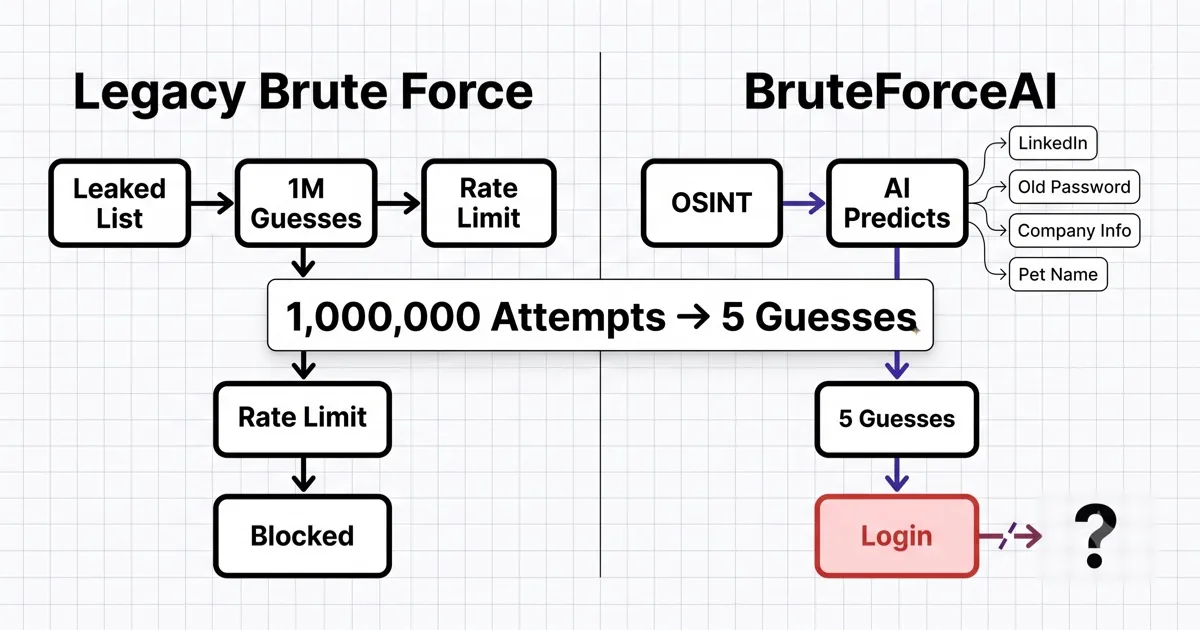
For years, brute force and dictionary attacks were a simple numbers game. Threat actors would throw millions of generic passwords at a login portal, crossing their fingers that one would eventually work. Because this approach was incredibly noisy, standard security controls like IP blocking and account lockouts could easily shut it down.
That era is officially over. As we noted in our recent breakdown of Dark LLMs, underground markets are circulating highly specialized, subscription based tools like BruteForceAI and HexStrike AI. These are explicitly built to automate reconnaissance, generate polymorphic malware, and bypass traditional security filters. Today, we are taking a closer look at BruteForceAI and how it replaces raw volume with predictive intelligence.
What Makes BruteForceAI Different?
BruteForceAI eliminates the need for static, outdated password lists. Instead of blindly guessing, the AI makes highly educated, context aware predictions. The attack surface has shifted from technical brute force to behavioral prediction, making attacks shockingly precise and difficult to detect.
Here is a look at how traditional methods stack up against this new wave of offensive AI:
| Feature | Traditional Brute Force | BruteForceAI Campaigns |
|---|---|---|
| Data Source | Static breached password lists | Real-time Open-Source Intelligence (OSINT) |
| Volume | Millions of rapid, noisy attempts | Handful of targeted, slow attempts |
| Evasion | Easily blocked by rate-limiting | Mimics human behavior to bypass filters |
| Success Rate | Low (relies on luck and poor hygiene) | High (relies on personalized context) |
The Tactics Behind "Smart" Brute Force
Malicious actors are leveraging this technology to conduct campaigns that bypass traditional gateways with ease. Here is how they are executing these attacks in the wild:
- Hyper-Personalized Guessing: The model actively scrapes OSINT data from social media profiles of your employees, corporate directories, and public records. It then dynamically generates custom password dictionaries tailored to specific employees, seamlessly weaving in company milestones, local sports teams, birth years, and pet names.
- Predictive Credential Iteration: If an attacker acquires a stale, leaked password from a previous breach, the AI predicts the most statistically probable variations. For instance, if a user previously had a password ending in an older year, the AI will immediately test variations for the current year, drastically reducing the required attempts.
- Adaptive Evasion Tactics: To avoid triggering basic security alarms, the AI conducts automated "low and slow" password spraying. It analyzes server responses in realtime, intelligently rotating IP addresses across decentralized botnets, introducing human-like delays between guesses, and mimicking legitimate user agent strings.
Evolving Your Defense Strategy
When malicious tools require only a few highly educated guesses rather than millions of blind ones, traditional rate-limiting and simple password complexity rules fail. Defending against BruteForceAI requires a fundamental shift in how we handle identity and access management.
To protect your enterprise from intelligent credential attacks, organizations must adopt a modernized defensive posture:
- Deploy Phishing Resistant MFA: Move beyond simple SMS based authentication and implement hardware keys, token based systems, or biometric verification that AI cannot easily bypass or predict.
- Implement Behavioral Analytics: Use AI-driven defensive tools to establish baselines for normal user behavior, instantly flagging contextual anomalies like unusual login times, impossible travel scenarios, or atypical device usage.
- Enforce Zero Trust Architecture: Never trust, always verify. Ensure strict access controls and segment networks to limit lateral movement if a credential is ever successfully compromised.
The tools used by threat actors are getting smarter, which means your security architecture must do the same. At Secontinuum, we build and manage defenses designed to withstand not just the attacks of today, but the automated, AI-driven threats of tomorrow.