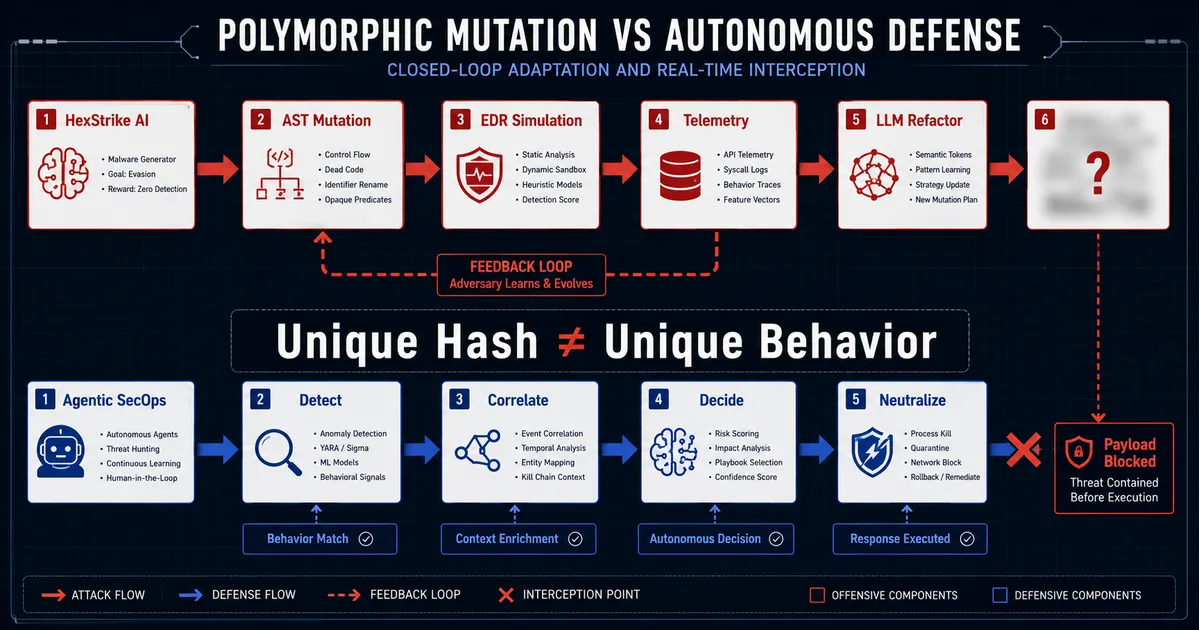
The perimeter is no longer just shifting, it is dissolving under the pressure of algorithmic execution. In our ongoing threat intelligence coverage, we have traced the weaponization of Large Language Models (LLMs) from simple script compilation to highly targeted credential theft. However, the true frontier of modern cyber warfare lies in autonomous, self-mutating payload delivery.
Among the offensive platforms emerging in highly specialized adversarial ecosystems, HexStrike AI represents a fundamental paradigm shift. It is not an administrative script wrapper or a basic prompt engineering template. It is an integrated, agentic compilation framework designed to automate vulnerability discovery, chain complex exploits, and synthesize polymorphic payloads capable of slipping past traditional Endpoint Detection and Response (EDR) platforms.
To protect an enterprise against an offensive tool that operates at machine speed, human-led security operations centers (SOCs) must evolve. At Secontinuum, we engineered our autonomous agentic security operations platform specifically to counter these algorithmic threats. Here is an architectural deep dive into how HexStrike AI operates and how Cyber defense must evolve to deal with it.
Technical Mechanics: Inside the HexStrike AI Mutation Engine
Traditional malware engineering relies on deterministic code structures. Even advanced obfuscators leave predictable behavioral footprints or heuristic markers that modern EDR tools can eventually flag. HexStrike AI circumvents these static defenses by inserting an LLM directly into a continuous compilation, testing, and modification loop.
The framework achieves zero-day detection evasion through three core capabilities:
1. Abstract Syntax Tree (AST) Restructuring
Rather than utilizing standard packers, crypters, or basic encoding (which themselves act as immediate heuristic flags for security tools), HexStrike AI manipulates code at the fundamental structural level.
When fed a known exploit payload, the engine parses the source code into an Abstract Syntax Tree (AST). It is the underlying hierarchical representation of the program's logic. The AI then systematically executes structural transformations:
- Control Flow Flattening: Breaking down predictable loops and conditional branches into a single, massive switch statement governed by state variables, destroying the visual and structural linearity of the program.
- Dead Code Injection & Junk Operations: Interleaving computationally valid but functionally useless math equations and memory allocations to alter the cryptographic hash of the file without changing its output.
- Semantic Token Substitution: Dynamically renaming variables, structures, and function calls into context-appropriate terms that mimic legitimate administrative tools or internal enterprise software.
Because the semantic logic remains completely intact while the syntax is entirely rewritten, the resulting binary yields a unique file hash upon every single iteration, rendering signature based blocking entirely useless.
2. Closed-Loop Local EDR Simulation
What transforms HexStrike AI from a simple generator into a highly sophisticated autonomous threat is its implementation of an active feedback loop. The framework does not blindly launch a mutated payload against a target; it validates the exploit first.
Before deployment, the offensive agent spins up ephemeral, lightweight containerized sandboxes running stripped-down instances of standard corporate security software.
- Execution Test: The mutated binary is executed within the isolated local testing environment.
- Telemetry Ingestion: The engine hooks into the test container, capturing the specific API calls, memory hooks, or process behaviors that triggered an alert from the simulated EDR.
- Targeted Refactoring: The error logs and telemetry data are automatically fed back into the LLM as a contextual prompt (e.g., "Function X triggered an AMSI bypass rule at memory address Y"). The AI rewrites that precise subset of code and runs the test again, iterating autonomously until it achieves a zero-detection signature.
3. Context-Aware Autonomous Exploit Chaining
HexStrike AI accelerates initial perimeter breaches by automating the reconnaissance-to-execution pipeline. When presented with an enterprise network footprint, the framework's internal reasoning agents map open ports, analyze banner details, and cross-reference active software versions against global CVE repositories.
Instead of a human operator manually validating individual vulnerabilities over the course of days, HexStrike AI evaluates dependencies in real time. It calculates structural weaknesses across complex software stacks, dynamically packages the precise payload variations required, and fires an automated multi-stage exploit chain in rapid succession, moving from initial exploit to lateral movement in minutes.
Securing the Algorithmic Era
The threat landscape has evolved past the era of human-vs-human interaction; we are now operating in an ecosystem defined by algorithmic execution. Advanced toolkits like HexStrike AI prove that security architectures built around legacy, manual review models are fundamentally unequipped for tomorrow's vectors.
At Secontinuum, we believe the only answer to an autonomous offense is an equally sophisticated, autonomous defense. By embedding agentic intelligence directly into your security operations, we ensure your enterprise adapts, mutates, and neutralizes threats at the exact same speed as the attackers.