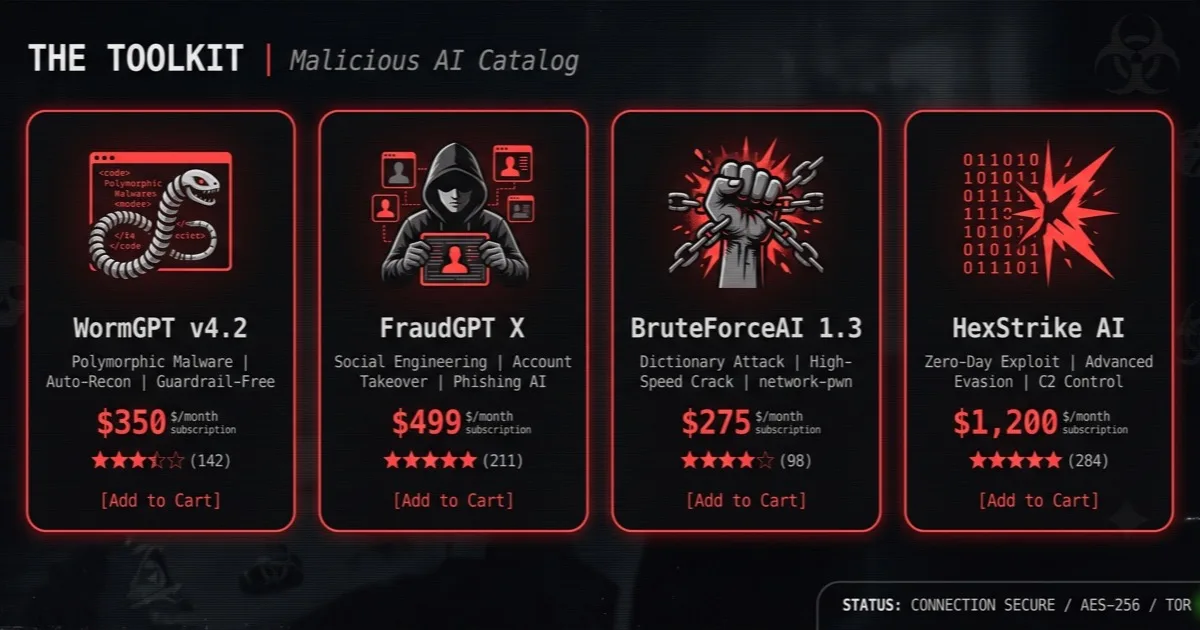
The AI revolution isn’t just empowering defenders; it has become the ultimate force multiplier for cybercriminals. For years, the cybersecurity community has warned about the theoretical dangers of artificial intelligence falling into the wrong hands. We are no longer just theorizing about AI risks; we are witnessing an industrialized, AI-driven offense in the wild.
At Secontinuum, our focus is on keeping organizations ahead of the curve. To do that, we must understand exactly how adversaries are weaponizing the very technologies we use to innovate.
The Rise of "Dark LLMs"
What is driving this shift? The rapid commercialization of "Dark LLMs".
While mainstream AI models have strict ethical guardrails, malicious actors are operating without limits. The underground ecosystem has matured rapidly. We have moved far beyond the early days of WormGPT and FraudGPT.
Today, underground markets are circulating highly specialized, subscription-based tools, like BruteForceAI and HexStrike AI, explicitly built to automate reconnaissance, generate polymorphic malware, and bypass traditional security filters. These are not mere toys for hackers; instead, they are enterprise-grade software solutions designed for illicit profit.
How AI is Actively Changing the Battlefield
The introduction of malicious LLMs has fundamentally altered the economics and mechanics of cyberattacks. Here is how malicious AI is actively changing the battlefield:
- The Velocity Gap: The attack lifecycle is shrinking rapidly. Historically, compromising a network required extensive manual effort. What used to take days of manual research and custom code generation can now be executed in mere minutes via a prompt. Attackers can scan a target enterprise's perimeter, identify vulnerabilities, and generate an exploit code almost instantaneously.
- Flawless Phishing at Scale: Grammar mistakes are a thing of the past. Phishing used to be easily identifiable by poor spelling and awkward phrasing. Today, AI generates hyper-personalized, contextually accurate emails that can fool even vigilant employees. Recent data from ENISA indicates that AI-supported phishing campaigns now represent over 80% of observed social engineering activity worldwide.
- Democratized Cybercrime: Dark LLMs have drastically lowered the barrier to entry. You no longer need to be a seasoned programmer to launch a devastating attack. Low-skill attackers can now leverage "Cybercrime-as-a-Service" models to execute highly sophisticated, targeted attacks.
Evolving Your Defensive Posture
Warning: As attackers work smarter, not harder, enterprises must evolve their defensive postures to match the speed and scale of modern threats. You cannot fight AI-powered attacks with a manual defense.
Fight AI with AI: Traditional detection techniques are no longer sufficient against polymorphic, AI-generated malware. Organizations need analytics and AI-enabled tools capable of identifying anomalies faster. The weaponization of Large Language Models represents a paradigm shift in cybersecurity. As the threat landscape evolves, proactive defense strategies are the only way forward.
Securing the Future with Secontinuum
At Secontinuum, we are dedicated to modernizing Cyber Defense for the modern enterprise. Agentic Detection to Containment in 45 seconds.