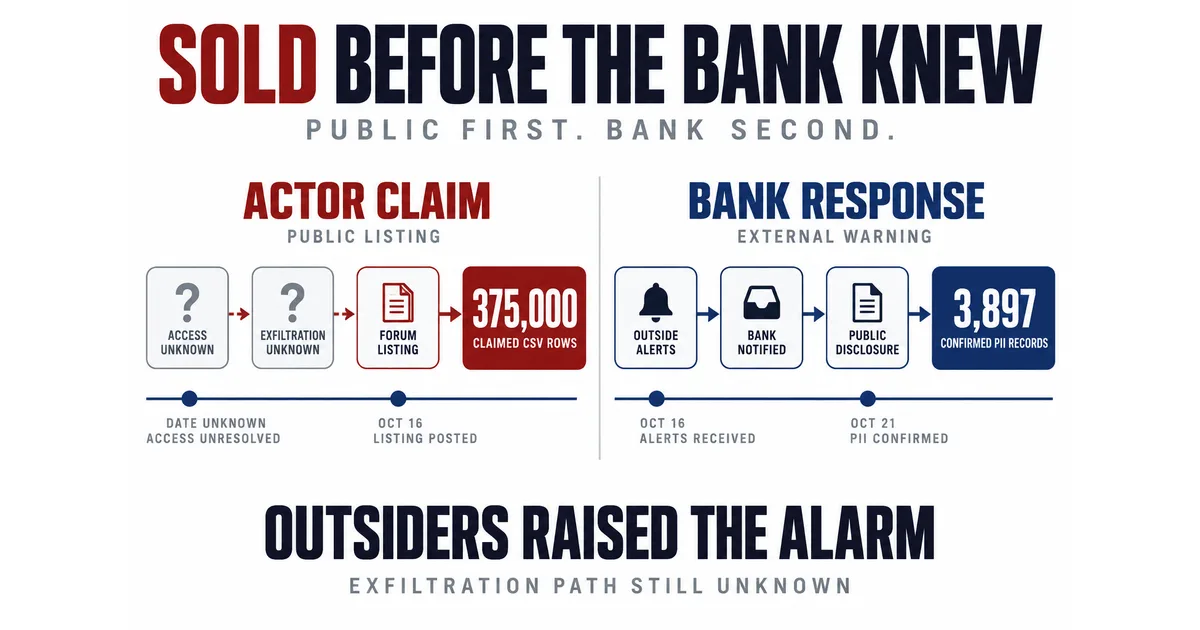
On October 16, 2026, a threat actor calling itself Siriusim posted a dataset on BreachForums that it said belonged to the State Bank of India: roughly 375,000 rows of customer data in CSV format and 2,722 PDF documents, including loan applications and account-opening forms. The same day, SBI was alerted by three outside parties: its threat intelligence provider, the Defence Cyber Agency, and CERT-In. Five days later, the bank told the stock exchanges that it had confirmed 3,897 customer records containing personally identifiable information in the exposed set.
The most important fact in this incident is not the record count. It is the direction the alert travelled. India's largest lender did not detect the exfiltration. It found out after the data was already published, from people outside its walls.
Timeline of the Incident
| Date (2026) | Event |
|---|---|
| Oct 16 | Siriusim lists ~375,000 CSV rows and 2,722 PDFs on BreachForums, presented as a first release, with four sample records as proof. The OSINT account CyberPulse56 flags the listing on X. |
| Oct 16 | SBI receives alerts from its threat intelligence provider, the Defence Cyber Agency and CERT-In. |
| Oct 19–20 | Media outlets report the claim. SBI does not respond to requests for comment. |
| Oct 21 | SBI files a Regulation 30 disclosure with BSE and NSE titled "Incident involving Data Loss", confirming 3,897 PII records and engaging a CERT-In-empanelled forensic agency. |
| Oct 21 | The Internet Freedom Foundation writes to SBI, the RBI and CERT-In, noting the filing is silent on whether affected customers have been told. |
At the time of writing, SBI has not said how the data left its environment, how old it is, or what the remaining ~371,000 records contain. The RBI has not commented publicly.
What Was Exposed
SBI's filing and subsequent reporting describe the confirmed records as containing:
- Identity: full names, gender, dates of birth
- Contact: registered mobile numbers, email addresses, residential addresses
- Banking identifiers: branch details and CIF (Customer Information File) numbers
- Lending pipeline data: lead IDs and metadata tied to loan and lead records
The threat actor's claims go further. Reporting on the four sample records indicates the phone numbers were real, that most entries related to loans, and that some samples included KYC material and Aadhaar numbers. None of the PDF content has been independently verified, and SBI's filing does not address the 2,722 documents at all.
Analyst note: 375,000 rows does not mean 375,000 victims. Lead and loan systems routinely hold multiple rows per person. But it cuts both ways: loan and account-opening PDFs typically carry scanned identity and address proofs. If those documents are genuine, the real blast radius could be far larger than 3,897, and far longer-lived. A password can be rotated. An Aadhaar or PAN copy cannot.
Reading the Data: Where Did It Come From?
The forensic investigation is ongoing, so attribution of the access vector is not possible yet. But the shape of the dataset is itself an indicator, and it is worth reasoning through.
The presence of lead IDs, loan application metadata and customer-acquisition entries, rather than transaction histories or account balances, points away from the core banking system and toward the lending origination and lead management layer. In Indian retail lending, that layer is often the most distributed part of a bank's estate: direct selling agents (DSAs), outsourced call centres, fintech partners, CRM platforms and document-upload portals all touch it. The IFF raised exactly this question in its letter to the bank.
Based on comparable incidents in the sector, the plausible paths cluster around a few ATT&CK techniques:
- T1199 – Trusted Relationship: a vendor, DSA or partner with legitimate access to lead data is compromised or abuses that access. This is not hypothetical in Indian banking: SBI credit card data was previously siphoned by insiders at a third-party call centre and used for OTP fraud.
- T1078 – Valid Accounts: stolen or infostealer-harvested credentials for a CRM, loan origination system or document portal. The July 2026 Bank of Baroda incident began with a single compromised employee mailbox.
- T1530 / T1213 – Data from Cloud Storage or Information Repositories: an exposed bucket, shared drive or misconfigured document store holding application PDFs. SBI has history here too: in 2019 an unprotected server in its Mumbai data centre leaked SBI Quick customer data.
- T1567 – Exfiltration Over Web Service: bulk export of CSVs and PDFs to attacker-controlled storage, blending into ordinary HTTPS traffic.
These are hypotheses for defenders to test against, not findings. Until the forensic report is published, the honest position is: the bank does not yet know, and neither does anyone else outside the investigation.
Why This Data Is Dangerous: The Fraud It Enables
The leaked fields are not a random assortment. Together they form a near-complete impersonation kit.
A caller who already knows your name, date of birth, home branch, CIF number and the loan you applied for last quarter does not sound like a scammer. They sound like your relationship manager. Standard advice to "never share your OTP" assumes the customer can tell the fraudster from the bank. This dataset erodes that assumption.
Expect the downstream activity to follow a familiar pattern:
- Targeted vishing and smishing: "loan verification" or "KYC update" calls that quote real application details to extract OTPs, UPI PINs or remote-access app installs.
- SIM-swap attempts: registered mobile numbers paired with identity documents are exactly what a SIM-swap social engineer needs at a telecom store.
- Synthetic and stolen-identity lending: genuine KYC documents can be reused to open mule accounts or apply for instant loans at other lenders.
- AI-scaled social engineering: this is where the agentic era changes the economics. A dataset of this kind can now be fed into LLM-driven calling pipelines and voice agents that personalise each script, run thousands of conversations in parallel, and adapt in real time. The cost of a convincing, individually tailored fraud call has collapsed to fractions of a cent.
The window between leak and monetisation is short. Every day of silence toward affected customers is a day the fraud operators have the information advantage.
The Real Lesson: An Outside-In Detection Model
Strip away the specifics and the SBI incident reveals a structural problem shared by most large enterprises: the organisation's own security operations were not the first to know.
Consider what had to go undetected for this to happen:
- Hundreds of thousands of rows and thousands of documents were collected and moved out of the environment.
- Whatever identity, vendor or storage path was used, its activity did not trip an alert that led to containment before publication.
- Discovery came only when the data surfaced on a criminal forum and external intelligence parties connected it back to the bank.
Then the regulatory clock compounds it. CERT-In's 2022 Directions require incident reporting within six hours, and the RBI's cyber framework for banks expects an initial report within two to six hours. Yet the obligations that currently bind are owed to regulators, not to customers: the customer-notification duty in Section 8(6) of the DPDP Act only comes into force in May 2027. The RBI's own March 2026 advisory recommends notifying affected customers, but it is not binding. The result is an incident that can be fully compliant on paper while the people most at risk are still unaware.
The gap is not a tooling shortage. Banks of SBI's scale have SIEMs, DLP and threat intel subscriptions. The gap is speed and correlation: the signals that could have caught bulk export from a lending or vendor system exist in the logs, but a human-paced SOC drowning in alerts rarely stitches them together in time.
Closing the Gap: Machine-Speed Detection Inside the Perimeter
Preventing the next version of this incident means detecting the exfiltration, not the listing. That requires continuous, autonomous correlation across identity, application and network telemetry, especially in the third-party-heavy systems where customer data actually lives.
This is the problem Secontinuum Vynnn, the Autonomous SOC, is built to solve:
- Guard (Telemetry Triage): Baselines normal access to lead management, loan origination and document repositories. A vendor account exporting tens of thousands of records, or a service principal suddenly pulling bulk PDFs at 2 a.m., is flagged as a behavioural anomaly in seconds, not discovered in a quarterly access review.
- Hunter (Correlation and Blast Radius): Correlates the export with identity logs, session origins, endpoint telemetry and egress traffic to answer the questions SBI is still working on: which account, which system, which records, and how far back the access goes.
- Scout (Adversary Context): Cross-references outbound destinations and observed infrastructure against external threat telemetry, so an exfiltration endpoint is tied to adversary context before the data shows up on a forum.
- Enforcer (Automated Containment): Revokes the compromised sessions and tokens, suspends the offending vendor integration, and blocks the egress path, cutting the transfer while it is still in progress.
The goal is simple: your SOC should be the first to know, not the last.
Recommendations
For banks and financial institutions:
- Treat the lending origination and lead pipeline as crown-jewel data. Map every vendor, DSA and partner that can read or export it.
- Enforce least privilege and just-in-time access for third parties; alert on any bulk export from CRM, LOS or document stores.
- Monitor for infostealer exposure of employee and vendor credentials, the initial access vector behind a growing share of 2026 incidents.
- Build customer notification into your cyber crisis plan now, as the RBI advisory recommends, rather than waiting for May 2027.
For SBI customers:
- Treat any call, SMS, email or WhatsApp message that quotes your loan or personal details with suspicion. Knowing your details does not make the caller the bank.
- Never share an OTP, PIN, password or install a remote-access app at a caller's request.
- Report suspicious activity to SBI and to India's national cybercrime helpline on 1930 or at cybercrime.gov.in.
We will update this analysis as SBI's forensic findings are published.