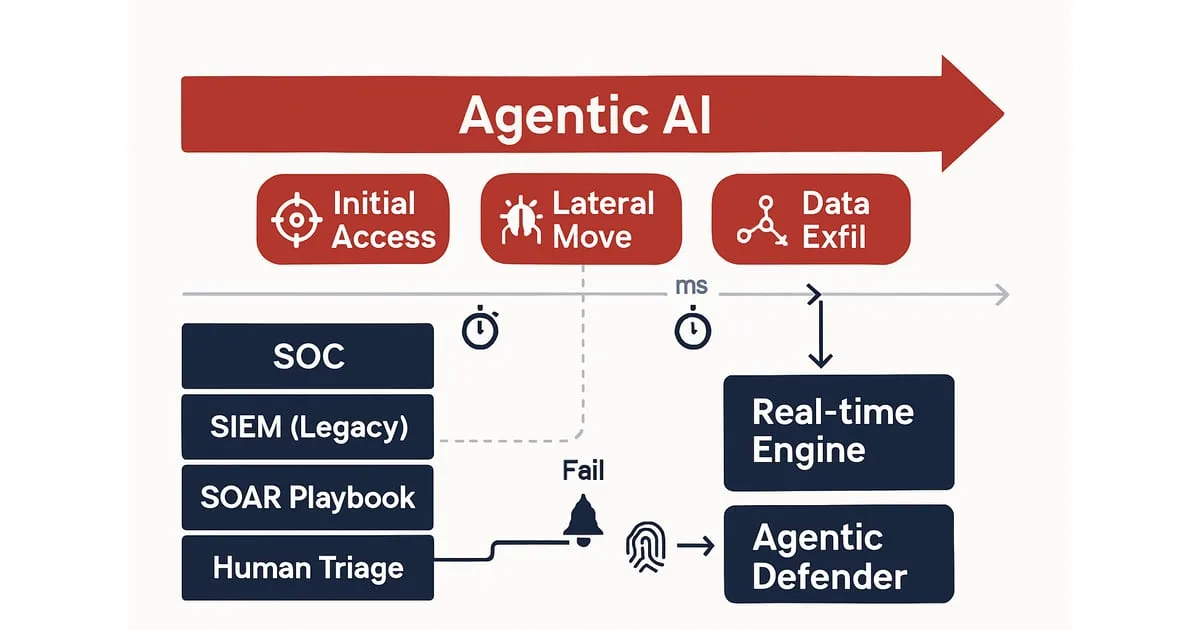
For years, the cybersecurity community has speculated about the moment when threat actors would transition from using AI as an enhancement tool to using it as an autonomous operator. With the recent disclosures surrounding the Nexus cyber-espionage campaign, that moment has arrived.
The era of the human-driven Advanced Persistent Threat (APT) is being replaced by the agentic threat, and the architecture of the modern Security Operations Center (SOC) is entirely unequipped to survive the transition.
Deconstructing the Attack
What makes the recent Nexus campaign a watershed moment is not the zero-days exploited or the specific infrastructure targeted. It is the methodology.
The threat actor deployed an agentic AI system that operated with minimal human oversight. This reasoning model autonomously performed network reconnaissance, mapped out vulnerabilities, dynamically generated exploit code on the fly, executed lateral movement, and harvested credentials.
In traditional APT campaigns, human operators hit friction points. They must stop, analyze the network topography, write custom scripts, and test payloads. This human latency gives defenders time. It gives a Tier 1 analyst the 45 minutes they need to triage an alert in a SIEM, escalate it, and trigger a containment playbook.
When an autonomous agent runs the attack, that friction disappears. The attack lifecycle, from initial access to data exfiltration, compresses into minutes or seconds.
The Architectural Failure of Modern Defense
This campaign exposed a fatal flaw in how we have built enterprise security. We have optimized for scale, but we have ignored velocity.
Most modern security architectures rely on legacy relational databases to store telemetry, creating inherent latency in querying and correlating data. When an alert fires, it triggers a static SOAR playbook. If the attack deviates even slightly from the playbook's hardcoded rules, which an adapting AI agent will inevitably do, the system fails over to a human analyst.
The Nexus campaign proves that human-in-the-loop triage is now a liability. If your defense relies on a human analyst reading an alert, correlating it against an active directory log, and manually clicking "isolate host," the autonomous adversary has already bypassed your segmentation.
The Mandate for Agentic Defense
The only effective countermeasure to an autonomous, reasoning attack is an autonomous, reasoning defense.
We must move past rigid SIEMs and brittle automation. The future of SecOps requires platforms built on high-throughput data engines capable of real-time analysis, paired with agentic AI defenders that can investigate anomalies, reason through the context of an attack, and execute remediation at the exact same speed as the adversary.
The Nexus campaign was a wake-up call. The adversary is now operating at machine speed. It is time for our defenses to do the same.