Cybersecurity has officially entered the era of the autonomous adversary. As we have seen with the rise of frameworks like HexStrike AI, modern malware no longer follows a static, pre-written script. It thinks, learns, mutates its own code, and adapts to your defenses in real time.
Against an adversary that writes its own instructions on the fly, traditional SIEMs (Security Information and Event Management) and SOAR (Security Orchestration, Automation, and Response) platforms are functionally obsolete. Linear playbooks that rely on static log queries or wait for a human analyst to manually parse EDR alerts simply cannot outpace malware that pivots every few seconds.
To defeat agentic malware, your centralized logging and response hub must become agentic itself.
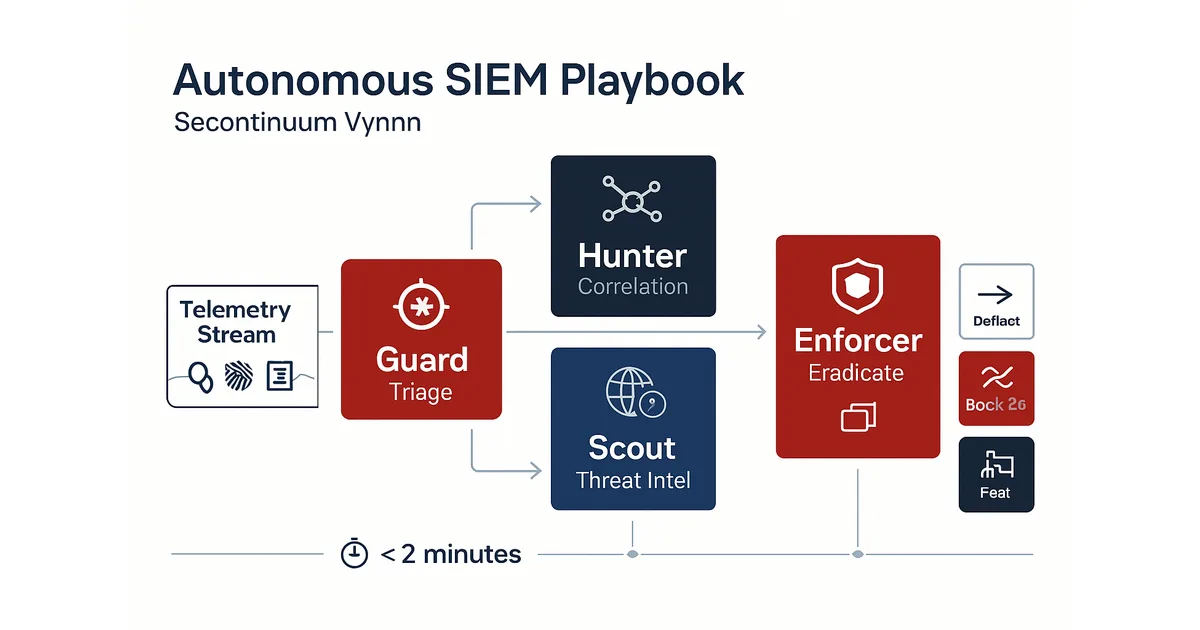
At Secontinuum, we engineered Vynnn to be the industry's first true Autonomous SIEM. Rather than relying on a monolithic, rules-based engine, Vynnn operates through a coordinated swarm of specialized AI agents: Guard, Hunter, Scout, and Enforcer.
Operating as the central brain of your security stack, Vynnn ingests raw telemetry from your existing EDRs, firewalls, and system logs. Here is exactly how these four agents coordinate in real time to triage, correlate, investigate, and eradicate an autonomous malware outbreak—long before it can establish a foothold.
The Autonomous SIEM Playbook in Action
Imagine a scenario where a user downloads a seemingly benign file. Hidden inside is an AI-driven payload designed to evade standard EDR signature detection, execute in memory, and autonomously map the internal network.
Because the payload is polymorphic, the endpoint EDR does not block the file outright. However, it does log the subsequent behavioral telemetry. Here is how the Vynnn swarm responds to that raw data stream.
Phase 1: Real-Time Log Triage (Vynnn Guard)
Traditional SIEMs wait for a pre-written rule to trigger an alert from a log. Vynnn Guard operates dynamically, continuously reading the stream of EDR logs, network telemetry, and identity events.
The moment the EDR logs a strange sequence—such as an unusual memory allocation followed by an unexpected child process—Guard recognizes the anomalous intent, even if the EDR flagged it as low-severity.
- Instant Triage: Guard immediately escalates the sequence, classifying the behavioral logs as an active threat rather than a benign anomaly.
- Proactive Isolation: Without waiting for a human analyst, Guard can initiate a micro-segmentation command via API, instructing the EDR to isolate the compromised endpoint from the broader corporate network while the investigation continues. It seamlessly hands the incident data off to the Hunter and Scout agents.
Phase 2: Deep Cross-Platform Correlation (Vynnn Hunter)
While Guard secures the initial endpoint, Vynnn Hunter maps the blast radius. Autonomous malware is rarely confined to a single node; it actively seeks out active directory misconfigurations to spread.
- Attack Chain Reconstruction: Hunter ingests the EDR telemetry from Guard and cross-references it across your entire log repository.
- Enterprise-Wide Sweeping: Hunter pulls Active Directory logs, firewall traffic flows, and proxy logs, correlating seemingly unrelated events—such as an anomalous login attempt on a separate server or a sudden spike in PowerShell activity. It stitches these disparate logs into a unified attack graph, identifying every hidden tendril the polymorphic malware has attempted to deploy across the enterprise.
Phase 3: Dynamic Threat Intelligence (Vynnn Scout)
While Hunter maps the internal network logs, Vynnn Scout looks outward. Agentic malware relies on decentralized, self-migrating Command and Control (C2) infrastructures to receive its operational goals.
- External Contextualization: Scout takes the external IP addresses and domain requests found in your DNS and proxy logs and cross-references them against the global intelligence fabric.
- Adversary Mapping: It pulls realtime data on the attacker's dynamic C2 domains and maps the observed EDR log behaviors directly to the MITRE ATT&CK framework. Scout identifies that the adversary is utilizing a specific tactic (e.g., T1562 - Impair Defenses) indicative of an advanced APT campaign, feeding this synthesized intelligence directly to the Enforcer.
Phase 4: Autonomous Eradication (Vynnn Enforcer)
Armed with the exact scope of the breach from Hunter and the external threat context from Scout, Vynnn Enforcer acts as the muscle, reaching back through your security stack via API integrations to execute a surgical strike.
- Targeted Neutralization: Enforcer commands the EDR to terminate the malicious processes globally across all affected endpoints.
- Infrastructure Hardening: It automatically pushes dynamic blocklists to your enterprise firewalls and web gateways, severing the malware's connection to its external C2 swarm based on Scout's intelligence.
- System Healing: Finally, Enforcer issues commands to purge lingering artifacts from system memory and registry keys, validating through subsequent log ingestion that the compromised endpoints have been rolled back to a pristine state.
Closing the Velocity Gap
When an autonomous AI agent attacks your network, every passing second allows it to learn more about your environment, mutate its code, and burrow deeper into your infrastructure.
By functioning as an Autonomous SIEM, Secontinuum Vynnn transforms your existing security logs from a passive repository of past events into an active, machine-speed defense mechanism. By orchestrating the specialized capabilities of Guard, Hunter, Scout, and Enforcer, the platform executes this entire defensive playbook—from the initial EDR log ingestion to complete system healing—in under two minutes.
The security architecture of tomorrow cannot rely on human reaction times. It must rely on intelligent agents capable of working together to decisively outmaneuver the adversary.