For decades, the vulnerability management lifecycle operated on a predictable schedule. A vulnerability was discovered, a CVE was published, and security teams were granted a grace period to evaluate patch notes and deploy fixes.
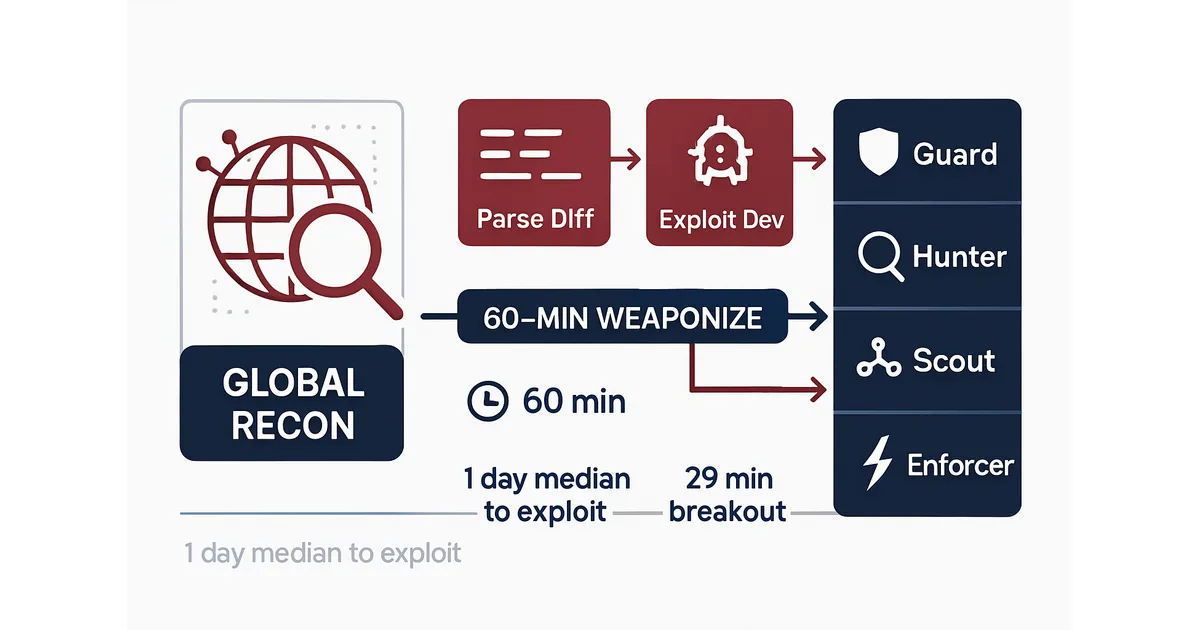
Today, that grace period is entirely gone. The attack lifecycle is shrinking rapidly. We are actively tracking a landscape where the median time to exploit vulnerabilities reached 1 day in 2026. This critical metric means threat actors are actively weaponizing and exploiting flaws before public disclosure or patch releases even occur.
Effectively, AI has turned every vulnerability into a zero-day. Here is a technical breakdown of how AI accelerates exploit generation, conducts global reconnaissance, and how autonomous SecOps levels the playing field.
Global Reconnaissance via Search Tools
What used to take days of manual research and custom code generation can now be executed in mere minutes via a prompt. Modern adversaries are no longer manually scanning IP blocks. Instead, offensive AI frameworks utilize global search tools and advanced Open-Source Intelligence (OSINT) to automate reconnaissance.
By plugging into internet-wide scanners and search engine APIs, an agentic AI can dynamically map the entire internet's attack surface in real time. When a new vulnerability is teased or whispered about on developer forums, the AI searches its global index for enterprise environments running the vulnerable software versions, creating an immediate, targeted hit list before a patch is ever compiled.
The 60-Minute Zero-Day Weaponization
Once the target list is acquired via global recon, the weaponization phase begins. Our threat intelligence Agent - Scout recently tracked a event where Agentic AI successfully converted a disclosed Firefox vulnerability into a fully working, weaponized exploit within one hour.
By reverse-engineering patch diffs, solving memory constraints autonomously, and testing payloads in local simulation loops, AI bypasses human development timelines entirely.
The metrics surrounding the speed of modern breaches illustrate exactly why manual Security Operations Centers (SOCs) are failing.
- According to the CrowdStrike 2026 Global Threat Report, the average breakout time—the time it takes an attacker to move laterally after initial compromise—dropped to just 29 minutes (down from 48 minutes a year ago).
- The fastest recorded breakout time was an astonishing 27 seconds.
When a zero-day exploit is generated in 60 minutes and lateral movement happens in under a minute, enterprise patching SLAs cannot keep pace.
Empowering Defenders: Detect, Contain, Respond—at Machine Speed
We must aggressively pivot away from human-speed reaction and embrace machine-speed execution. Human defenders shouldn't have to manually scramble through disconnected logs to catch machine-speed intrusions.
This is where Secontinuum Vynnn, our Autonomous SOC, empowers security teams to stay ahead of these zero-day factories. By continuously ingesting EDR telemetry, identity events, and network logs, Vynnn's specialized 4-agent swarm takes over the operational grind:
- Guard (Real-Time Ingestion): Detects abnormal memory allocation or unauthorized process spawning triggered by an exploit payload, initiating instant endpoint micro-segmentation.
- Hunter (Correlation): Sweeps your entire log architecture to determine if the same zero-day pattern is being attempted against other nodes in your environment.
- Scout (Threat Intel): Contextualizes the behavioral markers against emerging search-tool recon patterns and dynamic C2 infrastructure.
- Enforcer (Automated Action): Pushes dynamic blocking rules to firewalls and web gateways while terminating malicious processes across all endpoints.
Vynnn autonomously triages, correlates, and neutralizes threats in under 2 minutes in automated mode providing comprehensive context without cutting corners. It gives your team the critical breathing room needed to operate securely, ensuring that even when a zero-day hits, your organization remains resilient.